Is Scopus polluting its own database by indexing junk articles? A case study of five journals
Jackie Earle Haley
Abstract
The aim of this short research note is to demonstrate that Scopus is polluting its own databases, unintentionally or otherwise, by indexing junk articles. I have used five journals indexed by Scopus in this research note as examples in a case study format. I have found that the publication rate of junk articles for these five journals increased after they began to be indexed in Scopus. These journals are publishing conference papers and graduate students’ initial research reports in which there are many errors. This makes the indexing of The Journal of Social Sciences Research (Online ISSN: 2411-9458/Print ISSN: 2413-6670) questionable as it was considered for evaluation before its current two year publication history, (source: https://suggestor.step.scopus.com/progressTracker/?trackingID=49844DA5933F47A8). The quality of its published articles is very poor, and it has advertised and promoted false figures for its impact factors. These journals publish articles that are out of their scope and publish every article on condition of payment of a fee by the author that averages out to about 400 USD per article. Given that these journals have been advertising and promoting fake impact factors prior to their being indexed in Scopus and given that Scopus has included them in its central index, they are deceiving young researchers and the broader academic community with false information. Beall (2016) has previously pointed out the issue of the falsified impact factor information in his list of predatory journals. Many universities subscribe to Scopus to, among other reasons, measure the impact of their faculty members' research.. There is therefore a need to address the ethics of this situation, and this study recommends that Scopus carefully index new journals but observe the publication rates of junk articles, and if an indexed journal makes such an error, to take a decision within three months and impose a lifetime ban on indexing the journal.
Key words: Junk articles, scholarly databases, Scopus, Predatory journals
1.Introduction
There is no doubt Scopus is one of the largest abstract and indexing / citation databases of peer-reviewed literature: scientific journals, books and conference proceedings. Delivering a comprehensive overview of the world's research output in the fields of science, technology, medicine, social sciences, and arts and humanities, Scopus features smart tools to track, analyze and visualize research.
Currently, Scopus is indexing non-peer-reviewed journals that publish virtually anything for money. This distorts the reputation of Scopus, yet Scopus remains aware of this issue and does not respond.
If anyone complains about a journal with proof that it's predatory and not conducting a bona fide peer review, Scopus responds by saying “you have own objectives and giving value to Scopus”.
In this research note, I will show that Scopus is indexing junk articles with examples from five journals. The five journals are as follows:
- International Journal of Engineering &Technology (UAE) - [https://www.scopus.com/sourceid/21100805731]
- The Journal of Social Sciences Research - [https://www.scopus.com/sourceid/21100870214]
- International Journal of Civil Engineering and Technology - [https://www.scopus.com/sourceid/21100785495]
- International Journal of Mechanical Engineering and Technology - [https://www.scopus.com/sourceid/21100808402]
- Journal of Engineering and Applied Sciences - [https://www.scopus.com/sourceid/21100231100]
2. How the five journals are published and were indexed in Scopus
2.1 International Journal of Engineering &Technology (UAE)
First, I will discuss the International Journal of Engineering & Technology (UAE): [https://www.scopus.com/sourceid/21100805731]. It published 25 and 27 articles in 2016 and 2017 respectively.
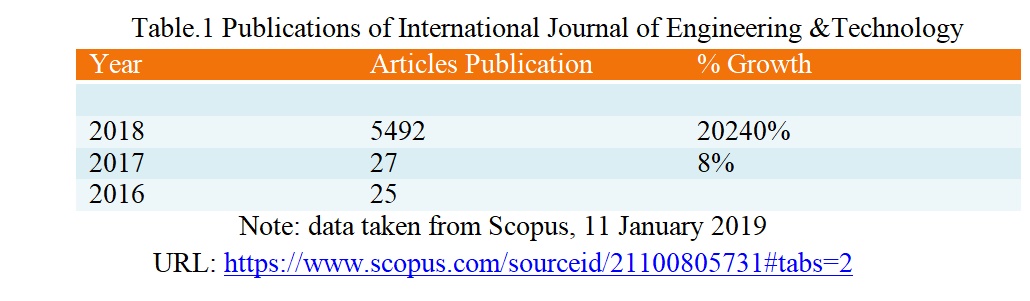
In 2018 the journal abandoned selectivity and published nearly 8,000 articles. Of these, and at the time of writing this note, 5,492 of them are indexed and available within the Scopus system, so these are the only ones I am considering for this study. Perhaps the Scopus team is happy that their indexing of articles has increased. The journal is approved for the following topics in Scopus:
- Chemical Engineering: General Chemical Engineering
- Computer Science
- Computer Science (miscellaneous)Biochemistry, Genetics and Molecular Biology
- Biotechnology, Environmental Science
- Environmental Engineering
- Hardware and Architecture
Many of the 5,492 articles are from the social sciences and out of scope for the journal. The journal has also published nearly 50 special issues including conference proceedings. The quality of such articles is low as they are selected for publication without peer review. A list of the special issues can be seen here:
https://www.sciencepubco.com/index.php/ijet/issue/specialIssue
2.2 The Journal of Social Sciences Research (Online ISSN: 2411-9458/Print ISSN: 2413-6670)
The Journal of Social Sciences Research (Online ISSN: 2411-9458/Print ISSN: 2413-6670) was accepted for indexing in April, 2018. Scopus began the journal’s evaluation when the JSSR had only been publishing for seven months: [URL: https://suggestor.step.scopus.com/progressTracker/?trackingID=49844DA5933F47A8]. Normally, according to Scopus’ journal evaluation policy, journals will be eligible for evaluation after two years of publication history. This journal was accepted for evaluation in December, 2015 when it had been publishing for only seven months.
My observation according to Scopus selection policy in table-2

The Journal of Social Sciences Research (Online ISSN: 2411-9458/Print ISSN: 2413-6670) was accepted for indexing in April, 2018. It was available live on 10th November, 2018 at the Scopus website. JSSR has started cheating and has published six special issues with a total of 527 articles in them within two months ( URL: https://arpgweb.com/journal/journal/7/special_issue) as shown in Table 3.
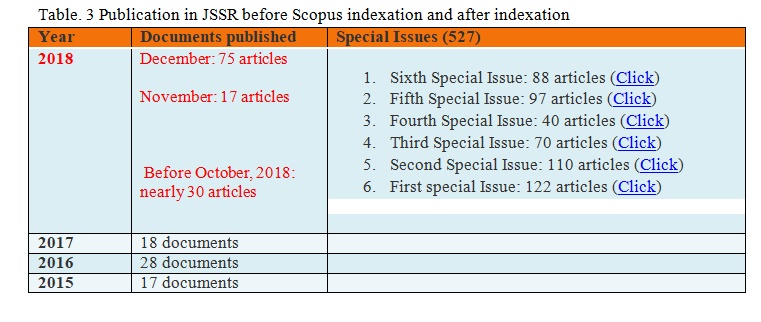
URL of Special issues: https://arpgweb.com/journal/journal/7/special_issue
If any scholar checks these articles, they will find them poorly written. Basically, these are the conference proceedings that are being used to become indexed in Scopus. These articles are not selected through a proper peer review process.
If the journal is delisted it needs to occur before Scopus’ reputation has been damaged. I suggest therefore that Scopus continues to index new journals but that it immediately delist any that have been found to be cheating the indexing process in this way.
2.3 International Journal of Civil Engineering and Technology - https://www.scopus.com/sourceid/21100785495]
This journal has been approved for indexing and covers the following fields: engineering: building and construction engineering: civil and structural engineering; computer science: computer networks and communications engineering: control and systems engineering. However it has covered the social sciences, economics and other fields in 2017 and 2018.
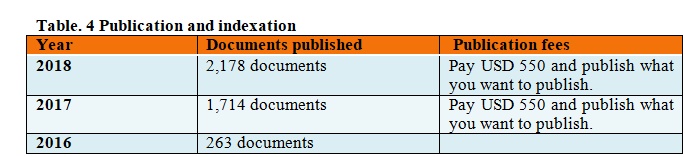
Sources: http://www.iaeme.com/ijciet/ijciet_charges.asp
Scopus has indexed published articles of this journal covering engineering, and computer science. There are social sciences articles listed under engineering. The quality of the articles is also poor.
This can be verified via the following link: http://www.iaeme.com/ijciet/index.asp. The journal also calculated its own fake impact factor: http://www.iaeme.com/Journal-Indexing.asp and is managing self-citations in order to increase it’s cite score in Scopus. The question is why Scopus has not taken note of these actions as yet.
2.4 International Journal of Mechanical Engineering and Technology- [https://www.scopus.com/sourceid/21100808402]
The International Journal of Mechanical Engineering and Technology is the hub of junk articles. The journal advertises itself like a product claiming that submissions will be evaluated within 24 hours after a receipt of payment of the publication fee is received and that Scopus will index the article within 15 working days after publication. It also claims that there is no need to worry about any KPI requirements, but that the journal’s team will assist authors submitting a five page article to be published and indexed in Scopus. When anyone calls up the journal, they have a publication fee listed for individual authors and conference organizers and that it will change if the conference organizer or author is unable to pay within 48 hours.

Source-1: http://www.iaeme.com/Ijmet/ijmet_charges.asp
Source-2: http://www.iaeme.com/Ijmet/index.asp
Table 6 shows that the fake impact factor is increasing every year by the journal publisher without any scientific justification. Scopus has considered the false information as an indicator of the quality of the journal during its evaluation.
2.5 Journal of Engineering and Applied Sciences - [https://www.scopus.com/sourceid/21100231100 ]
This journal is published by Medwell Publishers. Scopus delisted many journals in 2016 from Medwell publishers. The Journal of Engineering and Applied Sciences was not delisted. The journal is currently publishing 36 issues every year and it’s per article fee is 550 USD, and the quality of the articles is below average, affecting Scopus’ database. I have contacted Scopus and laid out my arguments regarding these five journals several times. Scopus is currently unwilling to respond to the arguments but have said that they will put the journals in a re-evaluation process. It will however require many academics to sign a petition to get a journal indexed or delisted.
In one email from Scopus I was told that I had my own objectives and that I was providing value to the Scopus brand and reputation.
3.Conclusion
This short note indicates that Scopus is indexing junk articles and polluting its own data base. The indexing of The Journal of Social Sciences Research (Online ISSN: 2411-9458/Print ISSN: 2413-6670) is questionable because it was considered for evaluation before it had been published for two years in direct contrast to Scopus' policy, the quality of its articles is poor and the journal is advertising false information on its impact factors. It had five citations at the time of indexation and four of them were in the applied sciences.
This study suggests that Scopus corrects this error as soon as possible by delisting this journal from the Scopus database. Even accounting for human error, the journal has now published 537 articles in six special issues within two months, violating Scopus' policy and using the re-evaluation factor of radar (outlier journal behavior), that is grounds for immediate delisting from Scopus. The other four journals have changed their publication policies after indexation in Scopus. Prior to being accepted into Scopus, the journals published good quality papers according to its aim and scope. As such there is no comment on their selection but instead on their practices after the journal was accepted for indexing by Scopus.
It is recommended that Scopus delist these journals immediately to save its reputation as a reputable scholarly database.